Thursday, December 5, 2013

K.A.C. 2013 - T - 20 ...

     Today we celebrate our K.A.C. mascot, KRAMPUS! Why? Because all over Europe, today (December 5th) is the Eve of Saint Nicholas, also known as Krampus Night or Krampusnacht. He was the star of our very first entry on November 12th, 2009, and has been haunting these pages ever since! His tale has been told and re-told across the Continent and slowly but surely he has made his presence known here in America. This year the Big K. has come on with a vengeance - check out this recent article from The Atlantic (with GREAT pictures)!

http://www.theatlantic.com/infocus/2013/12/krampus-saint-nicholas-dark-companion/100639/

     
      The busy one has been stuffing naughty children into his sack for a LONG time - how long exactly? Per Wikipedia: 
     

“The history of the Krampus figure stretches back to pre-Christian Germanic traditions. He is sometimes said to be the son of Hel, from Norse mythology. He also shares characteristics, including goat-like ears, legs, feet and feet, with the satyrs and fauns of Greek mythology. The early Catholic Church discouraged celebrations based around the wild goat-like creatures, and during the Inquisition efforts were made to stamp them out.


But Krampus figures persisted, and by the 17th century Krampus had been incorporated into Christian winter celebrations by pairing them with St. Nicholas.


Countries of the former Habsburg empire have largely borrowed the tradition of Krampus accompanying St.Nicholas on 5 December from Austria. However, in the Czech Republic and Slovakia the mythological figure (called čert) evolved from the Slavic demon chort and although nearly the same in appearance, it comes from a tradition distinct from that of Alpine nations.”


      And just to show HOW popular he is becoming in America, our favorite stocking (well, sack) stuffer is now available on ... appropriately enough, this great stocking! :) It's available from Archie McPhee at http://mcphee.com/shop/krampus-stocking.html for only $12.00!  That should keep the kiddies in their place! :) Also, there's one more Krampus item that is so amazing, we are giving it its own space in a later article ... bear with us, it's worth the wait! 

     Now I know what you're thinking, "Yeah, yeah, so there's a stocking and an article - Big Deal! It's not like American kids have ever really heard of him!" Wrong again! Most kids do know about him, as he has worked his way into different comics, books and TV shows (such as The Colbert Report, The Venture Brothers, American Dad and Scooby Doo)! Here's a clip from that:


     We'll leave you today with this audio tidbit: Tales of the Krampus ... listen and learn!


******************************************************

     More tomorrow!

Wednesday, December 4, 2013

K.A.C. 2013 - T - 21 ...

     Every year we here at the K.A.C. cover the annual showing of the most bizarre Christmas trees to make the rounds - and this year is no exception! Before we get to that, however, here is today's trivia bit that answers HOW these piney protagonists got their start as our holiday centerpieces:

      "Even before the arrival of Christianity, Germans decorated evergreen trees to brighten the dark, gloomy days of the winter solstice. The first "Christmas trees" appeared in Strasbourg in the 17th century and spread to Pennsylvania in the 1820s with the arrival of German immigrants. When Queen Victoria married Germany's Prince Albert in 1840, he brought the tradition to England. Eight years later, the first American newspaper ran a picture of the royal Christmas tree, and Americans outside Pennsylvania quickly followed suit." (Courtesy Time Lists)

     The picture at left is that of "the Queen's Christmas Tree", with a few changes. As Wikipedia points out: 


     "A woodcut of the British Royal family with their Christmas tree at Windsor Castle, initially published in The Illustrated London News December 1848, was copied in the United States at Christmas 1850, in Godey's Lady's Book. Godey's copied it exactly, except for the removal of the Queen's tiara and Prince Albert's moustache, to remake the engraving into an American scene. The republished Godey's image became the first widely circulated picture of a decorated evergreen Christmas tree in America. Art historian Karal Ann Marling called Prince Albert and Queen Victoria, shorn of their royal trappings, "the first influential American Christmas tree". Folk-culture historian Alfred Lewis Shoemaker states, "In all of America there was no more important medium in spreading the Christmas tree in the decade 1850–60 than Godey's Lady's Book". The image was reprinted in 1860, and by the 1870s, putting up a Christmas tree had become common in America."

     ******************************************************


    Fast forward to today and if you can stack it, you can turn it into a Christmas tree (of sorts). Case in point? This stuffed salamander tree at the Kyoto Aquarium in Japan. Just start with the larger ones at the bottom and circle around to the top with the smaller ones - voila!


     Perhaps you're more of a DIY type of person. Then these 26 Alternative Christmas Tree Ideas might be more up your alley, with everything from the Upcycled Pallet Tree to the HDTV Tree, there's something here for every budget. Word to the wise: be careful putting too many lights on the Cardboard Tannenbaum! 

http://www.trendhunter.com/slideshow/alternative-christmas-tree-ideas 

    
Finally, my vote for most novel tree of the year goes to the Eco Christmas Tree out of London. Looks like any other tree, right? Until you glance to the right ... what are those? A new type of Dalek? Nope, they are what powers the LED lights on the tree itself ... Brussells Sprouts! 1000, to be exact. Read about the whole experiment here!

http://www.trendhunter.com/trends/eco-christmas-tree

 ************************

     More tomorrow!

Tuesday, December 3, 2013

K.A.C. 2013 - T - 22 ...

     Hop aboard the Reindeer Express! Continuing our thread from yesterday regarding Santa and his sleigh, today's trivia concerns that red-nosed rascal Rudolph! Everybody knows the Gene Autry song by heart (and if you don't, just turn on the radio and wait a few minutes - it is played ALL THE TIME during the Christmas season!), but do you know how the red-nosed rangifer tarandus originally came to be? Would you believe as a store ad? Sad, but true, as the following item from Time Lists tells us: 

     "Like the Energizer Bunny, Rudolph the Red-Nosed Reindeer got his start as an advertising gimmick. A copywriter named Robert L. May first created the merry misfit in 1939 to lure shoppers into the Montgomery Ward department store. Frosty the Snowman and his famous corncob pipe couldn't escape the clutches of the advertising industry either; a whiskeymaker in 1890 used Frosty's likeness to showcase an entirely different kind of holiday cheer. Once Prohibition ended, the chain-smoking snowman quickly became the go-to guy for alcohol ads, appearing in posters for Miller beer, Jack Daniel's, Ballantine ale, Rheingold beer, Schlitz beer, Schenley, Oretel's lager beer, Chivas Regal scotch, Fort Pitt pale ale, Mount Whitney beer and Four Roses."

     Did you also know there were not one, but two sequels to Rudolph's story? In 1947, Robert May wrote Rudolph's Second Christmas, which went unpublished until 1991 when it appeared with the name change of Rudolph To the Rescue. In 1954, May wrote (and had published) Rudolph the Red-Nosed Reindeer Shines Again.

     **************************************************************************

         
And speaking of the Red-Nosed One, we once again turn to our friends at How Stuff Works to explain exactly HOW this whole 'glowing nose' effect is pulled off ... and WHY Rudy is the only one who has it!
Check it out!

http://tlc.howstuffworks.com/family/rudolph-red-nose-reindeer1.htm

     *****************************

     Join us again tomorrow as we explore another first, the earliest Christmas tree (along with some current photos of modern trees where people should have left well enough alone)!

Monday, December 2, 2013

K.A.C. 2013 - T - 23 ...


     Welcome back! Let me give you a behind the scenes look at how some of these K.A.C. entries come about. I always start with the idea of highlighting some aspect of Christmas or the season and begin to research it to find some interesting tidbit about it. Today my mind turned to Santa's sleigh. Now (kinky reindeer aside) I had always thought that Santa and his sleigh went together like PB & J, bread and butter, Krampus and bad children ... well, you get the idea. Turns out that was not always the case!

     I figured after so many repetitions of Clement Moore's 1823 poem 'Twas the Night Before Christmas (or to give it it's proper name A Visit From St. Nicholas) that this is where the whole "Santa and his sleigh" came from - not so! It came from a source even older than the poem (and from a friend of Moore's), writer Washington Irving. As Time Lists explains:

     "The author best known for creating the Headless Horseman also created the iconic image of Santa flying in a sleigh. In his 1819 series of short stories The Sketch Book of Geoffrey Crayon, New York native Washington Irving described a dream in which St. Nicholas soared across the sky in a weightless wagon. The stories became so popular, they spawned a Christmas revival of sorts in the States, and even Charles Dickens is said to have credited Irving's work for inspiring his classic holiday tale A Christmas Carol."

     So now you know ... and now I'M sitting here thinking of how with one jot of his pen, we could have wound up with the 'Headless Santa' instead! :)

     ************************

    
But what about the sleigh itself? Surely there's been some improvements made to it in almost 200 years? Funny you should ask! The good folks at How Stuff Works has the answer for you ... Santa's done a LOT of upgrading over the years and they break down for you just how he does his magic on Christmas Eve (hint: think Antimatter Propulsion Units and Nanotechnology) - go see! 


    http://people.howstuffworks.com/culture-traditions/holidays/santas-sleigh1.htm 

     **************************

     We'll continue this topic with a look at what happens should his souped-up sleigh break down - Plan B: The Reindeer!  Join us tomorrow!


Sunday, December 1, 2013

Welcome to the Kitschmas Advent Calendar 2013 !!! T - 24 Days ... and Counting !!!

     Hello again, boys and girls, and welcome to the 2013 edition of the K.A.C. !!! For those of you new to all this, see my Conjure Cinema entry from November 11th, 2011 (to see what you're about to get yourself into). For the rest of you, our annual Christmas Countdown begins today! 

     What with all the economic cutbacks each year, we here at the K.A.C. were forced to let most of our helpers go and only kept our two BEST workers (pictured at left) - they have consistently shown the standards of taste and quality (note I did not use the word "good" in that sentence) that you have come to expect from us year after year! Here is a nice candid shot of the boys perusing the piles of junk ... er, "quality material" ... to keep you amused until the Big Day! 

     We're starting on December 1st this year (yes, I'm well aware the K.A.C. has gotten shorter over time) because I'm usually swamped with everything going on at this time of year and I thought it would be more appropriate to get our calendar in line with traditional advent calendars (which start on this date). So tell your friends, tell your family, tell your neighbors - the K.A.C. is underway for another year! Let's open up our first door and see what today's "gift" is, shall we?

     ***************************************************************************

           Why not get an early start on sending out your Christmas cards AND horrify everyone you know by sending them the 'American Christmas Devil' card? Complete with an amazing anatomical breakdown including "fat man face", "stomach prince" and (my personal favorite) "celebration bowels" (click on the card to see it in ALL its glory). The whole story behind these crazy kaiju Christmas cards (and how to order them) can be found at the Paper Pushers
site below:

http://www.bradmcginty.com/?p=1366 

     Remember: Are Your Greetings Seasoned?

     ***********************************

     I thought I'd do something different with the K.A.C. entries this year and have a bit of Christmas trivia every day. Growing up in Boston, I have fond memories of going downtown once a year to see the amazing animatronic holiday window displays in the Jordan Marsh and Filenes department stores. From there it was time to walk through The Enchanted Village and then off to see The American Christmas Dev ... er, Santa Claus. I thought as a kid that Boston was the heart of Christmas celebrations and that it had always been like that in my hometown ... far from it, according to this snippet from Time Lists:

     
     "From 1659 to 1681, showcasing one's holiday spirit in Boston could cost you a fine of as much as five shillings. That's right — Christmas used to be illegal. It's somewhat surprising, then, that the same puritanical minds also created the first American batch of eggnog at Captain John Smith's 1607 Jamestown settlement. (The word nog comes from the word grog; that is, any drink made with rum.) Christmas was so inconsequential in early America that after the Revolutionary War, Congress didn't even bother taking the day off to celebrate the holiday, deciding instead to hold its first session on Christmas Day, 1789. It took almost a century for Congress to proclaim it a federal holiday."

     For more on this topic, read the short article "When Americans Banned Christmas" here: 

      http://theweek.com/article/index/222676/when-americans-banned-christmas

     Well, THAT ended on a rather cheery note, what? I promise to do better as the countdown continues - so join me again tomorrow and every day through the month of December as the K.A.C. snowball rolls out of control!

Tuesday, July 30, 2013

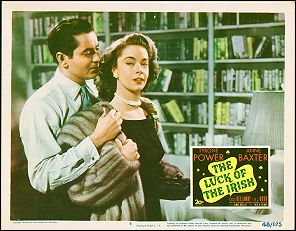
THE LUCK OF THE IRISH (1948) (shown March, 1994)

    Leprechauns are all about luck ... good luck, bad luck, tricky luck ... and it was just our luck when we originally tried to show this film in March of 1993 that a blizzard came roaring in and forced us to cancel the show! Not to be beaten, we waited one year (just long enough for a new batch of four-leaf clovers to sprout) and presented this bit of blarney.


     It involves reporter Stephen Fitzgerald (Tyrone Power), who is rushing to a seaside port in Ireland with his editor Bill Clark (James Todd). Fitzgerald has been offered a position with one of the biggest papers in New York and is eager for the job, the big city ... but most importantly, the money. While crossing an old wooden bridge in the car, the supports give way and the car sinks into the river, stranding the men and making Fitzgerald miss his boat. Fitzgerald goes to find help, telling Clark,"You stay here in the car in case someone comes along, and I'll scout up the road a bit. It must lead somewhere," to which he replies (in a nice bit of foreshadowing), "Don't be too sure. Irish paths are whimsical - like the Irish character."


     While walking through a forest, Fitzgerald comes upon an eccentric old fellow (Cecil Kellaway), who is dressed all in green with a buckle on his cap and fixing a pair of shoes. Sitting beside a small waterfall, he is so intent on his work he never notices Fitzgerald until he is standing before him. When the stranger asks for directions to the nearest village, he is floored. "You're not looking for me"? When he is told no, he is delighted and tells the young man where to go, then promptly disappears into the woods.

     Upon arriving at the village, the men take up residence at the Kittiwake Inn, where they meet innkeeper Tatie (J.M. Kerrigan) and his lovely daughter Nora (Anne Baxter, last seen by Conjure Cinema viewers in the 1970 TV movie RITUAL OF EVIL - see my October 7th, 2009 entry). Fitzgerald relates his encounter to Tatie, who stares gobsmacked throughout and tells him that he met a leprechaun! He tells the men about a villager who met and caught one once, forcing it to reveal his pot of gold and all the misfortune that followed the poor devil the remaining days of his life. Why? Because of a little-known fact: once you've caught the leprechaun and have his gold, you're supposed to spit on it to keep them from tricking you!

    
     That evening, Fitzgerald notices Tatie leaving a bottle of whiskey on the front step of the inn for the leprechauns. Fitzgerald says, "I thought the traditional thing for leprechauns was a glass of milk." A very offended Tatie replies, "Milk! Good night, Mr. Fitzgerald!"

     While getting ready for bed, Fitzgerald sees the leprechaun through his window gleefully running off with the whiskey and immediately takes off after him. Catching him in the forest, he demands the fellow unearth his pot of gold. The leprechaun is dismayed and tries to get out of doing so, but finally digs it up, bemoaning that it represents his savings of many lifetimes. Fitzgerald thinks this is all a stunt dreamed up by the old codger and Tatie, the innkeeper, and gives the pot back to the astonished leprechaun, who for a change can't believe his good luck and takes a shine to the clueless fellow, giving him a piece of gold to keep as a good luck piece.


     Others have taken a shine to Fitzgerald, as well, particularly Nora. He is a handsome and
refreshing change from the fishermen and other villagers she sees day in and day out, but she sadly knows nothing can come of their friendship, as he is eager to be away to the Big Apple and Big Money. While holding the coin (a Spanish doubloon) he wishes he could be on his way ... and the ship to take him across the ocean appears on the horizon! He still hasn't made any connections ... either to the wish and the coin or to Nora's feelings for him. He's a rather slow one, that Fitzgerald!

     Fast forward to New York City and Fitzgerald's meeting with newspaper editor David C. Augur (Lee J. Cobb), who knows and likes the young man. He should - Fitzgerald is engaged to his daughter! Augur is the man who offered Fitzgerald the job, but not for the newspaper. After years behind the desk, Augur has decided to run for the Senate and wants Fitzgerald on his team as his official speechwriter, which leads to this comic gem:

                             Augur: "You know the oldest and noblest occupation of them all?"
                             Fitzgerald: "I think so."
                             Augur: "I mean politics!"
                             Fitzgerald: "Well, you'll admit there are certain points of similarity."


      Upon his acceptance of the job, he is given all the perks: the keys to his own furnished apartment in New York City, complete with servant. Upon hearing this, Fitgerald says he's never had a servant in his life and wouldn't know what to do with one. He's voted down by Augur, who doesn't want him worrying about the menial things in life ... so he can completely concentrate on his speechwriting for the campaign. Knowing he's not going to win this argument, he goes off to meet Augur's daughter Frances (Jayne Meadows), who was the one responsible for getting him the job ... and the apartment ... and the furnishings. What Daddy's girl wants, Daddy's girl gets. Frances is a spoiled city girl through and through and is the diametric opposite of the plain and soft-spoken Norah. She has it all (including Fitzgerald) and knows it.

     The manservant arrives from the Acme Employment Agency, introducing himself as "Horace" ... and a suspicious Fitzgerald is sure he's seen him somewhere before. A few mishaps strengthen that suspicion (too strong drinks, stealing the milk left out in front of other people's doors), but he doesn't have time to ponder it. The next morning finds Fitzgerald being chauffeured on the way to a series of business meetings and lunches, all in the service of Augur. The car breaks down on a busy street and Horace suggests he take the subway, where his wallet is lifted and he runs into Nora, who is in New York to attend a wedding. Delighted, he goes with her to a news stand and tries to pay for her purchase only to find his wallet gone. Nora interprets this as his being broke and takes him to an Irish restaurant and has the proprietor feed him helping after helping of Irish stew to fatten him up, thinking he hasn't eaten! The wedding reception is going to take place there that evening and the proprietor invites Fitzgerald back to join in the celebration. He politely refuses, citing work.

     Later, as reporters are grilling Augur on his foreign policy, they read a statement that Fitzgerald wrote (before coming to work for him) that is the opposite of what Augur is pushing. After the reporters have left, Augur takes him aside and tells him to write a retraction piece about how he now sees it Augur's way ... essentially, to sell out. Resigned to the job, he goes in to write it up only to find Horace in his office (supposedly to bring him some handkerchiefs). While he thanks him, the following exchange occurs:

     Fitzgerald: "There's such a thing as taking one's job too seriously."
     Horace: "No, sir, not when your heart is in your work."
     Fitzgerald: "It's just a job, Horace."
     Horace: "No, sir, it's more than that. It's a life, indeed. When a man enters the personal services of another man, he must be prepared to surrender himself into that vocation. It's the master that matters, not the man. If the man takes to his work, the master's wish will become his wish ... the master's thought, his thought ... the master's soul, his soul. When the master gets hot, the man will cry out. When the master's nose itches, 'twill be the man who sneezes. He will live for the master, not for himself. Perhaps you will find it difficult to understand, because you ... you are the type that wears no man's collar. You are a proud, free man. It is for that reason that I am proud to serve you. Will that be all, sir?"

     The speech has its intended impact, causing Fitzgerald to go to Augur's home to resign. Cutting him off is Frances, who tells him of her father's future plans - to turn the editorship of the paper over to Fitzgerald after he has won his Senate seat. Fitzgerald gets an even better look at her own plans, as she wants to be a silent partner in running the paper according to her agenda. 


Confused, he leaves (without resigning) and goes to the wedding reception. Nora has been commandeered by an Irish fireman named Cornelius (Charles Irwin) for dance after dance. Fitzgerald pulls her aside repeatedly to talk to her, which leads to a brawl between the two men which (of course) spreads out to the entire restaurant. Fitzgerald is knocked out cold and awakes to find Nora tending him in the back room. They kiss and he walks her home, only to find out she is leaving on the next day's steamer back for Ireland. She invites him in, but he tells her he is getting married in a month to Frances. Her hurt look says it all and she wishes him a happy life. As he turns to head home, he reaches into his pocket for his doubloon ... only to find it transformed into a hunk of stone.

     Fitzgerald rushes home to find Horace working on shoes again and chases him all over the apartment, catching him and forcing him to admit his identity as the leprechaun that he first met. He asks Horace if he is responsible for Nora being in New York. He denies it, saying that was Fitzgerald's own thoughts that brought her over. Fitzgerald then asks if he is trying to ruin his life, to which Horace responds, "I offered you gold ... 'tis not my fault that you prefer a pebble." Horace sadly admits he is homesick for Ireland and can do no more for Fitzgerald and magically departs.

     We next see Fitzgerald at a blow-out dinner for Augur, who makes the announcement that Frances foretold. When Fitzgerald is called to the podium in front of the audience for a photo with Augur, he looks out and sees ... Horace! First one, then another, then a whole AUDIENCE of leprechauns (including the paintings on the walls) all grimly applauding his life choice. At that moment Fitzgerald refuses the position - when he is asked what his own plans are, he responds, "I haven't any ... except to sit under a waterfall with an old friend on mine." He then gently breaks off his engagement with Frances and leaves.

     The final scene is back at Tatie's inn, with Fitzgerald, his wife Nora and their friend (and his editor) Bill Clark. They all retire to their rooms for the evening, when Clark realizes he forgot his pipe downstairs. He goes back for it only to see Fitzgerald leaving a bottle of whiskey on the front doorstep, "for an old friend, in case he gets cold," he says. The final shot shows Horace picking up the bottle, smartly saluting Fitzgerald, and prancing merrily back to the forest.

     **************************************************************************
     The first thing that strikes me about the film is the running similarities to I MARRIED A WITCH (1942, see my blog entry from September 29th, 2009). Both starred Cecil Kellaway and both involved magical creatures getting involved with modern politics to change people's lives. This film is the more gentle fantasy of the two, as WITCH has a somewhat darker tone in certain spots of the film, particularly Kellaway's 'Daniel', who is always trying to think of ways to kill off Frederic March's Wallace Wooley character.

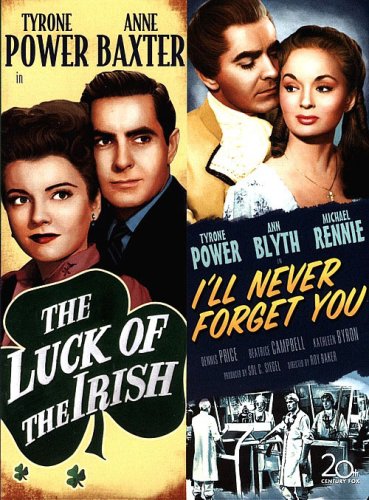
          The film is available on DVD in a Tyrone Power double feature disc (along with I'LL NEVER FORGET YOU) and as part of the Tyrone Power Matinee Idol Collection box set. It also pops up every March on such stations as Turner Classic Movies, always around St. Patrick's Day, surprise, surprise. Give it a look if you're in the mood for a cute tale of the wee folk.

     *********************************************

     Next Time: Fantasy of a whole different nature, as the legend of St. George and the Dragon is given the B.I.G. treatment by "Mr. Big" himself, Bert I. Gordon, in THE MAGIC SWORD! 

Thursday, May 9, 2013

RIP Ray Harryhausen: 1920 - 2013


     Conjure Cinema pays its respects to the passing of the master of stop-motion animation, Mr. Ray Harryhausen. Please read my tribute below:


http://sites.bu.edu/kraskerfilm/category/ray-harryhausen/