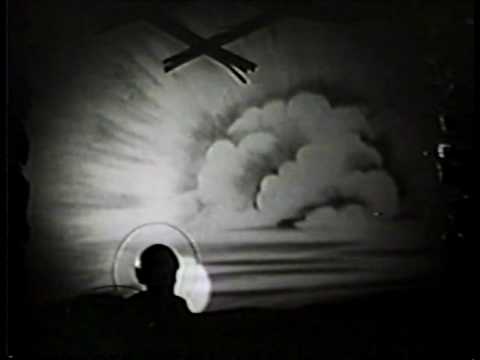
August of 1993 featured our annual Conjure Cinema UFO Party and, knowing it was to soon be upon us, I had spent the better part of the year searching for what is considered to be the very first UFO documentary. The modern UFO era is generally believed to have begun with Kenneth Arnold's widely-reported sighting of nine UFOs over Mt. Rainier, Washington, on June 24th, 1947. While being interviewed by reporters, the United Press quoted Arnold as saying, "They were shaped like saucers and were so thin I could barely see them...", and so the term 'flying saucers' was born.
Three years later, the first documentary on these phenomena was released. Running less that 15 minutes, THE FLYING SAUCER MYSTERY covers a lot of ground for its length. After Arnold's original sighting, the floodgates were opened and other witnesses came forth with photos, videos and some truly bizarre stories (with none stranger in the early days than George Adamski and his contactee tales of traveling around to the different planets with the crews of the saucers!) - the documentary shows recent photo and video footage, all the while purporting some of the current theories of what the UFOs could possibly be. It also includes interviews with authors Frank Scully and (one of the most famous of the early writers on the subject) Major Donald Keyhoe.
Keyhoe's breakthrough article, entitled "The Flying Saucers Are Real", was originally published in the January, 1950 issue of TRUE magazine and proved so popular and talked-about he expanded it into what is considered the first serious look at the phenomena (Keyhoe is seen in the documentary holding a copy of the book seen at left). It was followed up by more books and articles on the subject.
When I tracked the documentary down (via Sinister Cinema), it came with about 30 minutes of different 'flying saucer' trailers to expand the length of the tape, showcasing such films as THE FLYING SAUCER, U.F.O. and Ray Harryhausen's opus EARTH VS. THE FLYING SAUCERS. But this still made for a very short running time for our show ... what to do?
Sheerly by chance, I looked up my old buddies at the Unarius Academy of Science (see my blog entry for September 1st, 2009) and lo and behold, they were offering a SEQUEL to their jaw-dropping UFO feature THE ARRIVAL! So quick as a speeding saucer, I ordered THE ARRIVAL, Part Two (aka ROOTS OF THE EARTHMAN) ... and proceeded to regret it. Sadly NOT capturing lightning in a bottle twice, Part 2 has none of the charm of the original ARRIVAL, nor the cheesy effects ... turns out it doesn't even have a SCRIPT (I am not making that up)! The folks at Unarius claimed that their 'actors' were channeling their past lives through 'psychodrama' and re-living their contacts with the Space Brothers, exactly as it happened so many millennia ago ... in a washed-out gully ... with their Texas accents.
Half as funny and unfortunately twice as long as the original, this film is notorious in Conjure Cinema's history as being the only film to make a viewer cry! I introduced the film, let it run and at the end of the tape brought the lights up to a semi-stunned crowd (who were berating it throughout), and told them the bad news: that was only Tape 1 of 2! Whereupon one of our viewers burst into tears, saying, "It's just SO bad!"
Bravely sitting through Part 2 (although it didn't get better) was a tough slog, but one that you felt you could wear with a badge of, if not honor, then pride that you had survived it! :) The lights came up, our battered but never beaten audience gave each other the look of a shared painful experience and went into the night, sadder if not wiser ... well, definitely sadder!
Before I close out this entry, in case you're mourning the fact that you weren't there with us, not to worry: here's the entire documentary for your viewing pleasure!
http://www.youtube.com/watch?v=w-gobjVfFiQ
And because you need to see it, here's a taste of the original Unarius film (plus the opportunity to order the DVD!) ... scroll down and see the clip! Enjoy!
http://www.unarius.org/store/the-arrival-p-86.html
Next Time: Back to Earth and the epic 1956 Russian fantasy ILYA MUROMETS or, as it was known in America, THE SWORD AND THE DRAGON! Strap on your armor and join us!
Thursday, April 28, 2011
Wednesday, March 16, 2011
THE DAY THE EARTH FROZE (aka SAMPO) (1959) (shown July, 1993)
With the arrival of the sweltering summer heat, I felt a change of pace was in order and scheduled this film, which was not at ALL what I was expecting when I first saw it! I knew nothing about it save the title when I first encountered it (as part of the 2009 16mm estate sale I was brokering {see my entry of August 27th, 2009}) and thought it was going to be some 1950s sci-fi feature that I had missed from my youth. I couldn't have been more wrong.
Study the poster at the left. Looks intriguing, yes? Two blond, Nordic types backing away from a giant, alien eye. Then there's the ballyhoo advertising promising "thousands against an ominous diabolical force from another world" (italics mine). Last but not least there's the cast. Marvin Miller I was at least aware of, he of the sonorous voice who had narrated countless films of this type and had done voice-overs on a number of television series, as well as starring in the 1955 TV show THE MILLIONAIRE. The other cast members, however, left me scratching my head. Nina Anderson? Jon Powers? Where had I seen them before? Nowhere, as it turns out ... and thereby hangs our tale ...
Roger Corman, in addition to producing and directing a number of low-budget features of his own, had another talent, which we'll call the 'stock footage switcheroo'. He would find a European feature (usually of the science fiction variety), keep the special effects footage, add his own actors while dubbing over the original ones, and completely change the plots. His best trick of this type was once making TWO separate features with the SAME footage - three years apart! If you're brave, watch 1965's VOYAGE TO THE PREHISTORIC PLANET and 1968's VOYAGE TO THE PLANET OF PREHISTORIC WOMEN back-to-back. It's brain-numbing!
Roger's company (Filmgroup) purchased the American distribution rights to this film, re-dubbed it, re-cut it, re-voiced it and released it unheralded as the bottom half of a number of AIP double features of the time, after which it was quickly sold off for TV reruns. It's a shame, because the tale of the film itself is MUCH more interesting ...
The original tale of SAMPO comes from the epic Finnish poem, the Kalevala (for more on this amazing work, see this link: http://en.wikipedia.org/wiki/Kalevala). A statue of the author of this work, Elias Lönnrot, comes to life to begin the film. The story concerns the love between Lemminkainen (Andris Oshin), a soldier and woodcutter and Annikki (Eve Kivi), a lovely young maiden. For their impending nuptials, Annikki's brother Ilmarinen (Ivan Voronov), the village blacksmith, undertakes to build the magical Sampo, a forged machine that will bring good fortune to the village, along with grain, salt and gold (think a metallic Horn of Plenty).
Someone else has been trying in vain to build a Sampo: the witch Louhi (Anna Orochko) - she has had her wizened gnomes work her forge day and night to produce a Sampo, all to no avail. Frustrated and on the point of putting her lead blacksmith to death, she uses her magic and finds out Ilmarinen is the only one who knows the proper procedure for making the machine. Watching him and the lovely Annikki, Louhi hears of Ilmarinen's plans and makes plans of her own. When Annikki sits at the dock in the family boat, Louhi flings her black cloak across the sea, which speedily goes to Annikki and turns into the sail of her ship, kidnapping the young maiden and bringing her to the witch's clutches.
Lemminkainen and Ilmarinen go to her rescue. How? By cutting down an oak tree and carving it into a rescue craft. Yes, it WOULD have been simpler to just ... oh, BORROW somebody else's boat, but that's not how REAL heroes do these things! :) By the way, if ever there was a film where trees were an endangered species, this is that film. Between the opening shots of Lemminkainen and his friends cutting down a HUGE swath of trees, this boat-making scene and the finale, NO tree is safe in Finland!
Our heroes arrive on Louhi's island to rescue Annikki. She tells them they can have the girl, if they both promise to undertake one task for her in return. They agree, and Lemminkainen goes first. The task? He must plow a field of deadly snakes. Ilmarinen comes to his future brother-in-law's rescue by forging him a bronze horse. When the field is plowed, Louhi turns to Ilmarinen and demands his task ... yep, you guessed it. Build HER a Sampo! The problem: he can only make the magical machine ONCE - if he makes it for the witch, then his family and village will suffer. But Louhi will not accept any other gift, so he proceeds (with the help of her gnomes at the forge) to build it.
Looking like the world's biggest new age crystal (see picture at left), the Sampo cranks out the goods (grain, salt, gold, etc.) and Louhi releases Annikki. Annikki has a tale to tell the men: Louhi not only had her a prisoner in her cave, she has also imprisoned the Winds! They are kept chained in giant bladders, slaves to Louhi's will. This gives Lemminkainen an idea.
Ilmarinen returns to Louhi's forge one final time, bringing forth a magical steel boat to carry the three of them home. With the Sampo at her control, Louhi has no lost all interest in her captives and they sail away.
Upon seeing Annikki safely ashore back at their village, Lemminkainen does what any good hero would do: jumps BACK into the sea and SWIMS back to Louhi's island. It's been eating at him the whole trip that the witch should have THEIR Sampo and he is determined to get it back. Arriving at her island, Lemminkainen sneaks into the cave and releases one of the winds (in the form of a mist) that blocks out Louhi's sight. With the mist so thick, he steals the Sampo (and her boat) and sails back towards home.
Louhi disperses the mist and sees Lemminkainen on the sea. She releases the North Wind as a gale to crush the boat and drown the hero. The boat does capsize, taking the Sampo with it. In one of the coolest parts of the film, Lemminkainen's mother stands on the shore, watching and waiting for her son's return. She begs news from the trees, from the sky and from the road (which rises up bemoaning its fate, that of people trodding on it day in and day out - see picture at left). It is an effective and astonishing shot that had me smiling the first time I saw this. It also brings home the fact that all the different types of folk magic is second nature to everyone in the Finnish village of Kalevala - yes, Ilmarinen can bring forth the Sampo, but Lemminkainen's mother can call forth the inanimate objects to speak with her, and there are other examples just taken as given throughout the film.
Lemminkainen is eventually fished out of the sea, clutching a small piece of the Sampo (all he was able to recover before it sank). Even though it isn't the whole machine, just the fragment is guaranteed to bring happiness and prosperity to their village. The marriage between Lemminkainen and Annikki proceeds, but Louhi will have none of that, and in her insane rage at losing the Sampo, plays her final card: she steals the Sun out of the sky and imprisons it! Looking suspiciously like a studio floodlight (which it was - another piece of low-budget ingenuity by the filmmakers), the Sun is now held captive in Louhi's cave and the village and its people begin to freeze with the prospect of a never-ending winter (see, it took a while, but we FINALLY got to the reason behind the title of the film!) - the villagers are called together and decide to play THEIR final card: the magical kantele.
It has been a long-standing rule at Conjure Cinema (from the very beginning, actually) that the features we show cover some aspect of magic (hence our name). As a result, this has lead me on a two-decade (and counting) journey through World Cinema from every country and time, searching for the unusual, the rare and the unseen examples of magic in all it's cinematic forms. This is the only example I have seen of word magic (or Words of Power); specifically in this case, Songs of Power. The villagers once again call upon Ilmarinen to forge magical kantleles (the Finnish zither-like instrument seen to the left). Again, trees are sacrificed and all the metal in the village is taken to the forge to make the magical strings. When all is finished, the villagers walk across the frozen sea to Louhi's island to rescue the Sun. Louhi and her gnomes come out for battle, but the gnomes are so entranced by the sweet, bell-like tones of the kantele they fall asleep, and Louhi is turned into a pillar of salt from the music (!). The Sun is released back into the sky, the world warms again and the marriage (finally) proceeds.
SAMPO has been released in different versions: as the American-International cut-down, redubbed version THE DAY THE EARTH FROZE (which I've been discussing above) and as an episode of Mystery Science Theater 3000. Sadly, the original release of the film is unavailable (and long-overdue). Now, if you'll excuse me, I must attend to my forge ... I've got some grain and salt and gold to produce ...
Next Time: Keep watching the skies! I'll tell you all about our fourth Annual U.F.O. Party, where I pulled out all the stops with a showing of the very first documentary ever made about Flying Saucers and the return of a "certain someone" that actually made one of our viewers cry! :) It's all next time here at Conjure Cinema!
Thursday, February 10, 2011
JASON AND THE ARGONAUTS (1963) (shown June, 1993)
As you know (if you are a regular reader of Conjure Cinema), my favorite movie of all time is George Pal's 7 FACES OF DR. LAO. My second favorite film, and that only by a hair's breadth, is Ray Harryhausen's 1963 epic JASON AND THE ARGONAUTS.
Considered to be the masterpiece of his career (even moreso than his 7th VOYAGE OF SINBAD), it is a sprawling spectacle of (to quote the trailer), "Gods, like men, and men, like Gods, who live ... and love ... violently"! It tells the story of Jason (Todd Armstrong) and his men in their quest for the Golden Fleece. He undertakes the quest in order to regain his throne from King Pelias (Douglas Wilmer), who murdered Jason's family and usurped his kingdom. Pelias is warned by the Gods of Jason's arrival and has spent 20 years wondering how to thwart his enemy when he appears.
Pretending to be a supporter of Jason's cause, Pelias advises him to travel from Thessaly to Colchis ("the end of the world") and bring back the Fleece as a symbol of hope and renewal for Jason's reign. Jason ponders this at the temple of Hermes, all the while looking at a fallen statue of the messenger of the Gods. He is joined by the royal seer (also named Hermes) (Michael Gwynn), who tells him to ask the Gods for help with his problem. Dropping his mortal persona, Hermes appears in his Godly guise and spirits Jason to Mount Olympus, where he is given an audience with Zeus (Niall MacGinniss) and Hera (Honor Blackman). As Jason's sister had called to Hera for aid in Her temple before she was murdered by Pelias, the Goddess has become Jason's patron, and vows to help him on his quest. Zeus warns her she can only help Jason five times (the number of times Briseis called to her for aid).
A word here about Honor Blackman's Hera. Of all the actors in the film (portraying Gods and humans), she is my favorite. Hera has gotten short shrift by various filmmakers and has been the easy, "go-to" villainess in a number of film and television series. She is almost always portrayed as a vindictive shrew whose only goal is to make mortals miserable, especially those unfortunate women whom Zeus favored. Ms. Blackman makes the character what she always was meant to be, the Queen of the Gods - regal, capricious, noble, tender and caring - but able to go toe-to-toe with Zeus in his never-ending game with mankind.
Jason holds the first Olympic Games to find the best and bravest men for his crew, including Hercules (Nigel Green) and a very clever latecomer (who outwits Hercules in the discus throw), Hylas (John Cairney). The Gods watch bemusedly from on high in Mount Olympus via their reflecting pool (their version of the ultimate flat-screen TV! :)). The crew settle in for the long trip and (via montage) is shown getting restless, as their food and water run perilously low.
Jason appeals to Hera (who accompanies the Argonauts as a carved figurehead on the back of the ship) for assistance and is told to steer for the Isle of Bronze, but gives him fair warning to take food and water ONLY. Upon the island, Hercules and Hylas take off after some goats, to capture them for the voyage. Instead, they come across a valley of bronze behemoths, made by Hephaestus to showcase the glory of the Gods. One of the statues has a door ajar at its base, and Hercules and Hylas enter. It turns out to be a jewelry case for a Goddess, with pearls as big as man and a golden brooch pin which Hercules absconds with, saying it will make a good spear. Hylas tries to intercede, but is overruled by Hercules, and they step outside. It is here that Ray's Dynamation stop-motion animation first comes to life, in the form of the gigantic bronze warrior Talos (seen in the Italian two-sheet poster above).
Time for another aside: I have a good friend who does not like JASON (or Ray's 1981 second venture into Greek mythology, CLASH OF THE TITANS) because "they're not true to the myths". She's absolutely right. However, Ray has repeatedly gone on record saying that these were HIS interpretations of the myths - Talos is an excellent example. In one version of the original tale, Talos was a human-sized bronze man who guarded the island of Crete by patrolling the island and throwing boulders at ships trying to land. If invaders made it past the boulders, he would place himself inside a fire until he was red-hot, then find the invaders and hug them to him, burning them alive. I think we'll give Ray the benefit of the doubt for cinematic license here ...
After blocking their exit and destroying their ship, Talos returns to the island to systematically kill off the survivors. Jason calls again to Hera for aid, whereupon she tells him to look to the heels of the bronze giant. There he sees a cap, which he unscrews (while the Argonauts distract Talos) and sends the bronze man's life-blood streaming to the sand. The men scatter, Hercules dropping the spear in the process, and run for their lives from the toppling giant. Hylas tries to save the spear for Hercules and is crushed to death in the process.
Hercules refuses to accept the fact that Hylas is gone and stays on the island. Jason almost has a mutiny on his hand, but asks Hera to address the Argonauts one last time. She tells them all that they must go on to find Phineas, the blind seer (Patrick Troughton), as only he can guide them now. They set sail and come to the island where Phineas resides ... but not alone. He is constantly tormented by two hideous Harpies, sent by Zeus as punishment for abusing his prophetic powers. Phineas agrees to tell Jason how to get to Colchis and the Fleece, but only if he and the Argonauts meet his price - freeing him from the Harpies.
Jason agrees, and the scene is set for a wondrous nighttime trap, wherein the men capture the Harpies by draping large fishing nets over the entire temple. They capture and entrap the creatures, making Phineas their master now. He tells them they must pass through the Clashing Rocks to reach Colchis and gives Jason an amulet for protection and thanks. The Clashing Rocks in the film take the place of the double menaces Scylla and Charybdis from the original tale (see this link if you need a brush-up on them: http://en.wikipedia.org/wiki/Scylla_and_charybdis).
Cutting back to Olympus, we see Zeus is getting rather nettled over Jason's continual perseverance over the obstacles put in his way, and patiently waits to drop the Clashing Rocks on him and his crew. Another ship, coming from the opposite direction, attempts the channel first and is dashed to pieces. Jason orders the crew ahead in spite of what they have just seen ... and the rocks come tumbling down again. This leads to one of the highlights of the film ... and one of the few accomplished WITHOUT the use of stop-motion animation. Hera plays Her last card on the Olympian life-board and moves a particularly "fishy" statue next to the good ship Argo. Seconds away from being flattened, Jason (in frustration) tears off the protective amulet Phineas had given him and throws it into the roiling water. Instantly, to all their (and our) astonishment, the sea god Triton appears and HOLDS the Clashing Rocks apart, long enough for the Argonauts to pass safely through. It was only years later, while re-watching the film that it FINALLY occurred to me, "Well, how are they going to get BACK?" That part is never explained. :)
From the earlier wrecked ship, they find and rescue Medea (Nancy Kovack), High Priestess of Hecate, who tells them Colchis is only a day away. Upon reaching the shores of Colchis, she goes on separately and Jason and two of his men present themselves to King Aeetes (Jack Gwillim). Aeetes welcomes them and tells Jason he will prepare a feast for him and his men, to honor their legendary voyage. The feast is actually a trap, as a traitor among Jason's crew, Acastus (Gary Raymond), the son of Pelias, has warned Aeetes what the Argonauts are really there for. Aeetes has Jason and the Argonauts imprisoned, knowing that the theft of the Fleece would mean ruin for him and his kingdom. Acastus, however, has other plans ... with Jason and his men locked up, he slinks away to steal the Golden Fleece for himself.
That night, Medea frees Jason and his men by drugging the guards. Jason orders all but two of his men back to the Argo, to get the ship ready for a quick getaway as they head for the Fleece. Finding it hanging regally from the branches of a tree, Jason reaches up to take it ... and is confronted with his NEXT life-threatening situation, the seven-headed Hydra.
As challenging as this was for Ray to animate (trying to keep track of seven heads moving an inch at a time, at the SAME time), it would have been worse if he had stuck with the original myth. The original Hydra had a neat trick - if you struck off one head, TWO more would grow in its place! The Hydra has already killed off Acastus for his theft attempt and now comes after Jason, all heads a-snapping. Jason avoids the whole Hydra Head problem by going underneath them all and shoving his sword into the heart of the beast, killing it instantly.
Aeetes and his troops rush to the scene, but too late, as Jason and crew have "fleeced" them (sorry!) and are heading up the mountain to get back to the Argo. Aeetes stops his men from pursuing them, calling instead upon Hecate to revenge them by sending forth the "Children of the Hydra's Teeth ... the Children of the Night!" Fireballs come screaming down from the heavens, incinerating the slain Hydra and leaving just a skeleton. Aeetes has the Hydra's teeth gathered in a hat and he and his men pursue Jason to the plain on top of the mountain. Once there, he stops Jason and his men with a command and proceeds to sow the barren ground with the teeth. What happens next is instant cinematic history and the main reason this film is so beloved to fantasy fans.
Think animating seven Hydra heads a frame at a time is bad? Try animating seven sword-fighting skeletons vs. three sword-fighting men, all set to choreographed moves! The final result lasts four minutes on screen and took four and a half MONTHS to animate, with Ray sometimes only getting a few SECONDS worth of footage out of a day's work. The results are heart-stopping and were more than worth the effort. Medea is led to the Argo while Jason and his men fight for their lives against these denizens of Hell. Fun fact: next time you watch the film, take a close look at the shields the skeletons are using - the creatures on the front are all from Ray's previous films, including the Ymir from 20 MILLION MILES TO EARTH and the octopus from IT CAME FROM BENEATH THE SEA! Jason's two men succumb to the onslaught of the skeletons and, in desperation, he leaps off a high cliff (with the skeletons pursuing) to escape them and swim back to the Argo.
The film ends with Jason and Medea in a clench on the ship, with Zeus grudgingly admitting defeat, saying he has other plans for Jason, while Hera looks at the two young lovers (via the Olympian pool) wistfully. A beautiful end for a beautiful film.
Oddly enough, I did not originally see this in a theatre. I was visiting my grandfather and his neighbors had kids my age (I was nine years old) ... plus they had a color TV! JASON was being shown as the Friday night movie on TV and we all settled in to watch it - and I was completely blown away. The other kids thought it was cool, but I had a cinematic epiphany - I didn't know they MADE films like this! Soon after, I haunted our local library to find out all about the filmmakers, the actors and especially the people who made the monsters and how they did it. I was even MORE astonished to find out it was ONE MAN who had done the special effects, then proceeded to track down everything else he had done ... and it's been a life-long love affair ever since.
Many (many) years later, my best friend Mark and I had the good fortune to take Ray and his wife Diana out to lunch and chat with him about all things animation. They were both good sports about it, probably having heard our questions hundreds of times before, but were very gracious. Ray did tell me that for some reason Boston (where I'm from) always was a hard market for his films.
If you've never seen this (and I find that VERY hard to believe), it is available on every format you can think of. Columbia Pictures has always been aggressive in pushing Ray's films, and JASON has, at one time or another, been released on 8mm and Super 8mm film, 16mm film, Betamax tape, VHS tape, laserdisc (including a two disc Criterion release with a gatefold jacket detailing the voyage of the Argonauts), and regular and Blu-ray DVD. If at all possible, you need to get the Blu-ray (see the cover above). I spent the better part of two weeks re-watching the film and the extras and listening to both feature-length commentary tracks. As special effects technician and JASON fan Randy Cook says, "You won't see a better-looking version of this film in your lifetime". I agree - it is THAT good - I daresay it is almost better than when it was originally shown in theaters.
Whatever format you see it in, SEE IT! It is as fantastic and charming as ever, even approaching it's fiftieth anniversary. It may not have been what ancient Greece REALLY was like, but it certainly is what it SHOULD have been like.
Next Time: Oh, boy ... are we talking polar opposites here! From the Olympian heights of ancient Greece, we set out sight lower ... FAR lower, and go to ancient Finland in search of the Sampo! There's witches and captive winds, stolen suns and magic harps. It all comes your way in THE DAY THE EARTH FROZE! Be there!
Considered to be the masterpiece of his career (even moreso than his 7th VOYAGE OF SINBAD), it is a sprawling spectacle of (to quote the trailer), "Gods, like men, and men, like Gods, who live ... and love ... violently"! It tells the story of Jason (Todd Armstrong) and his men in their quest for the Golden Fleece. He undertakes the quest in order to regain his throne from King Pelias (Douglas Wilmer), who murdered Jason's family and usurped his kingdom. Pelias is warned by the Gods of Jason's arrival and has spent 20 years wondering how to thwart his enemy when he appears.
Pretending to be a supporter of Jason's cause, Pelias advises him to travel from Thessaly to Colchis ("the end of the world") and bring back the Fleece as a symbol of hope and renewal for Jason's reign. Jason ponders this at the temple of Hermes, all the while looking at a fallen statue of the messenger of the Gods. He is joined by the royal seer (also named Hermes) (Michael Gwynn), who tells him to ask the Gods for help with his problem. Dropping his mortal persona, Hermes appears in his Godly guise and spirits Jason to Mount Olympus, where he is given an audience with Zeus (Niall MacGinniss) and Hera (Honor Blackman). As Jason's sister had called to Hera for aid in Her temple before she was murdered by Pelias, the Goddess has become Jason's patron, and vows to help him on his quest. Zeus warns her she can only help Jason five times (the number of times Briseis called to her for aid).
A word here about Honor Blackman's Hera. Of all the actors in the film (portraying Gods and humans), she is my favorite. Hera has gotten short shrift by various filmmakers and has been the easy, "go-to" villainess in a number of film and television series. She is almost always portrayed as a vindictive shrew whose only goal is to make mortals miserable, especially those unfortunate women whom Zeus favored. Ms. Blackman makes the character what she always was meant to be, the Queen of the Gods - regal, capricious, noble, tender and caring - but able to go toe-to-toe with Zeus in his never-ending game with mankind.
Jason holds the first Olympic Games to find the best and bravest men for his crew, including Hercules (Nigel Green) and a very clever latecomer (who outwits Hercules in the discus throw), Hylas (John Cairney). The Gods watch bemusedly from on high in Mount Olympus via their reflecting pool (their version of the ultimate flat-screen TV! :)). The crew settle in for the long trip and (via montage) is shown getting restless, as their food and water run perilously low.
Jason appeals to Hera (who accompanies the Argonauts as a carved figurehead on the back of the ship) for assistance and is told to steer for the Isle of Bronze, but gives him fair warning to take food and water ONLY. Upon the island, Hercules and Hylas take off after some goats, to capture them for the voyage. Instead, they come across a valley of bronze behemoths, made by Hephaestus to showcase the glory of the Gods. One of the statues has a door ajar at its base, and Hercules and Hylas enter. It turns out to be a jewelry case for a Goddess, with pearls as big as man and a golden brooch pin which Hercules absconds with, saying it will make a good spear. Hylas tries to intercede, but is overruled by Hercules, and they step outside. It is here that Ray's Dynamation stop-motion animation first comes to life, in the form of the gigantic bronze warrior Talos (seen in the Italian two-sheet poster above).
Time for another aside: I have a good friend who does not like JASON (or Ray's 1981 second venture into Greek mythology, CLASH OF THE TITANS) because "they're not true to the myths". She's absolutely right. However, Ray has repeatedly gone on record saying that these were HIS interpretations of the myths - Talos is an excellent example. In one version of the original tale, Talos was a human-sized bronze man who guarded the island of Crete by patrolling the island and throwing boulders at ships trying to land. If invaders made it past the boulders, he would place himself inside a fire until he was red-hot, then find the invaders and hug them to him, burning them alive. I think we'll give Ray the benefit of the doubt for cinematic license here ...
After blocking their exit and destroying their ship, Talos returns to the island to systematically kill off the survivors. Jason calls again to Hera for aid, whereupon she tells him to look to the heels of the bronze giant. There he sees a cap, which he unscrews (while the Argonauts distract Talos) and sends the bronze man's life-blood streaming to the sand. The men scatter, Hercules dropping the spear in the process, and run for their lives from the toppling giant. Hylas tries to save the spear for Hercules and is crushed to death in the process.
Hercules refuses to accept the fact that Hylas is gone and stays on the island. Jason almost has a mutiny on his hand, but asks Hera to address the Argonauts one last time. She tells them all that they must go on to find Phineas, the blind seer (Patrick Troughton), as only he can guide them now. They set sail and come to the island where Phineas resides ... but not alone. He is constantly tormented by two hideous Harpies, sent by Zeus as punishment for abusing his prophetic powers. Phineas agrees to tell Jason how to get to Colchis and the Fleece, but only if he and the Argonauts meet his price - freeing him from the Harpies.
Jason agrees, and the scene is set for a wondrous nighttime trap, wherein the men capture the Harpies by draping large fishing nets over the entire temple. They capture and entrap the creatures, making Phineas their master now. He tells them they must pass through the Clashing Rocks to reach Colchis and gives Jason an amulet for protection and thanks. The Clashing Rocks in the film take the place of the double menaces Scylla and Charybdis from the original tale (see this link if you need a brush-up on them: http://en.wikipedia.org/wiki/Scylla_and_charybdis).
Cutting back to Olympus, we see Zeus is getting rather nettled over Jason's continual perseverance over the obstacles put in his way, and patiently waits to drop the Clashing Rocks on him and his crew. Another ship, coming from the opposite direction, attempts the channel first and is dashed to pieces. Jason orders the crew ahead in spite of what they have just seen ... and the rocks come tumbling down again. This leads to one of the highlights of the film ... and one of the few accomplished WITHOUT the use of stop-motion animation. Hera plays Her last card on the Olympian life-board and moves a particularly "fishy" statue next to the good ship Argo. Seconds away from being flattened, Jason (in frustration) tears off the protective amulet Phineas had given him and throws it into the roiling water. Instantly, to all their (and our) astonishment, the sea god Triton appears and HOLDS the Clashing Rocks apart, long enough for the Argonauts to pass safely through. It was only years later, while re-watching the film that it FINALLY occurred to me, "Well, how are they going to get BACK?" That part is never explained. :)From the earlier wrecked ship, they find and rescue Medea (Nancy Kovack), High Priestess of Hecate, who tells them Colchis is only a day away. Upon reaching the shores of Colchis, she goes on separately and Jason and two of his men present themselves to King Aeetes (Jack Gwillim). Aeetes welcomes them and tells Jason he will prepare a feast for him and his men, to honor their legendary voyage. The feast is actually a trap, as a traitor among Jason's crew, Acastus (Gary Raymond), the son of Pelias, has warned Aeetes what the Argonauts are really there for. Aeetes has Jason and the Argonauts imprisoned, knowing that the theft of the Fleece would mean ruin for him and his kingdom. Acastus, however, has other plans ... with Jason and his men locked up, he slinks away to steal the Golden Fleece for himself.
That night, Medea frees Jason and his men by drugging the guards. Jason orders all but two of his men back to the Argo, to get the ship ready for a quick getaway as they head for the Fleece. Finding it hanging regally from the branches of a tree, Jason reaches up to take it ... and is confronted with his NEXT life-threatening situation, the seven-headed Hydra.
As challenging as this was for Ray to animate (trying to keep track of seven heads moving an inch at a time, at the SAME time), it would have been worse if he had stuck with the original myth. The original Hydra had a neat trick - if you struck off one head, TWO more would grow in its place! The Hydra has already killed off Acastus for his theft attempt and now comes after Jason, all heads a-snapping. Jason avoids the whole Hydra Head problem by going underneath them all and shoving his sword into the heart of the beast, killing it instantly.
Aeetes and his troops rush to the scene, but too late, as Jason and crew have "fleeced" them (sorry!) and are heading up the mountain to get back to the Argo. Aeetes stops his men from pursuing them, calling instead upon Hecate to revenge them by sending forth the "Children of the Hydra's Teeth ... the Children of the Night!" Fireballs come screaming down from the heavens, incinerating the slain Hydra and leaving just a skeleton. Aeetes has the Hydra's teeth gathered in a hat and he and his men pursue Jason to the plain on top of the mountain. Once there, he stops Jason and his men with a command and proceeds to sow the barren ground with the teeth. What happens next is instant cinematic history and the main reason this film is so beloved to fantasy fans.
Think animating seven Hydra heads a frame at a time is bad? Try animating seven sword-fighting skeletons vs. three sword-fighting men, all set to choreographed moves! The final result lasts four minutes on screen and took four and a half MONTHS to animate, with Ray sometimes only getting a few SECONDS worth of footage out of a day's work. The results are heart-stopping and were more than worth the effort. Medea is led to the Argo while Jason and his men fight for their lives against these denizens of Hell. Fun fact: next time you watch the film, take a close look at the shields the skeletons are using - the creatures on the front are all from Ray's previous films, including the Ymir from 20 MILLION MILES TO EARTH and the octopus from IT CAME FROM BENEATH THE SEA! Jason's two men succumb to the onslaught of the skeletons and, in desperation, he leaps off a high cliff (with the skeletons pursuing) to escape them and swim back to the Argo.
The film ends with Jason and Medea in a clench on the ship, with Zeus grudgingly admitting defeat, saying he has other plans for Jason, while Hera looks at the two young lovers (via the Olympian pool) wistfully. A beautiful end for a beautiful film.
Oddly enough, I did not originally see this in a theatre. I was visiting my grandfather and his neighbors had kids my age (I was nine years old) ... plus they had a color TV! JASON was being shown as the Friday night movie on TV and we all settled in to watch it - and I was completely blown away. The other kids thought it was cool, but I had a cinematic epiphany - I didn't know they MADE films like this! Soon after, I haunted our local library to find out all about the filmmakers, the actors and especially the people who made the monsters and how they did it. I was even MORE astonished to find out it was ONE MAN who had done the special effects, then proceeded to track down everything else he had done ... and it's been a life-long love affair ever since.
Many (many) years later, my best friend Mark and I had the good fortune to take Ray and his wife Diana out to lunch and chat with him about all things animation. They were both good sports about it, probably having heard our questions hundreds of times before, but were very gracious. Ray did tell me that for some reason Boston (where I'm from) always was a hard market for his films.
If you've never seen this (and I find that VERY hard to believe), it is available on every format you can think of. Columbia Pictures has always been aggressive in pushing Ray's films, and JASON has, at one time or another, been released on 8mm and Super 8mm film, 16mm film, Betamax tape, VHS tape, laserdisc (including a two disc Criterion release with a gatefold jacket detailing the voyage of the Argonauts), and regular and Blu-ray DVD. If at all possible, you need to get the Blu-ray (see the cover above). I spent the better part of two weeks re-watching the film and the extras and listening to both feature-length commentary tracks. As special effects technician and JASON fan Randy Cook says, "You won't see a better-looking version of this film in your lifetime". I agree - it is THAT good - I daresay it is almost better than when it was originally shown in theaters.
Whatever format you see it in, SEE IT! It is as fantastic and charming as ever, even approaching it's fiftieth anniversary. It may not have been what ancient Greece REALLY was like, but it certainly is what it SHOULD have been like.
Next Time: Oh, boy ... are we talking polar opposites here! From the Olympian heights of ancient Greece, we set out sight lower ... FAR lower, and go to ancient Finland in search of the Sampo! There's witches and captive winds, stolen suns and magic harps. It all comes your way in THE DAY THE EARTH FROZE! Be there!
Wednesday, January 12, 2011
THE MASK (1961) (shown May, 1993)
But not just ANY mask. It is an Aztec sacrificial mask, found on Radin's last expedition - one over three thousand years old and still with the latent power to command men's minds and unlock their basest desires. It has taken hold of Radin, body and soul, and like the world's most addictive drug, is now making him do terrible things.
Barnes can not believe this and tries to find a more logical explanation for Radin's psychosis. Radin asks, "Would you like to try the Mask and see for yourself?" Before he can reply, Radin bolts from the office. At his apartment, Radin asks his landlady to mail a package for him, then takes a drink ... and blows his brains out.
Barnes receives the news from Police Lieutenant Martin (Bill Walker), and is upset that he has lost his patient, feeling himself to blame. As the Lieutenant leaves to speak with Radin's employer at the Museum of Ancient History, Pam Albright (Claudette Nevins), Barnes' fiancee' arrives. Consoling him, they both notice the box that has arrived and find it to be the mask. Pam leaves to pick up grocery items and Barnes finds a letter from Radin, challenging him to "Put ... the Mask ... On ... NOW!"
Up to this point, THE MASK is a fairly straightforward thriller. While advertised as a 3-D film, that's only half-true: it is actually only partially filmed in 3-D, showcasing the surreal sequences when the good doctor goes on his hallucinatory journeys via the commanding voice. It was a brilliant conceit that worked well in the context of the film, as the audience is instructed at the beginning to put on their glasses when hearing the voice, thus (by default) making the 'fourth wall' tissue thin, as the audience is, in effect, BECOMING Barnes when he dons the mask.
The 3-D sequences are the real reason to see this film. Executed by the famed experimental filmmaker and special effects expert Slavko Vorkapich (father of the 'montage sequence' in modern films, known to most filmmakers as the 'Vorkapich' effect ... and also the teacher of Art Clokey (of GUMBY & POKEY fame)), they are a true exercise in haunting surrealism. As I was re-watching these sequences, the first thing that popped into my head in trying to describe them was 'Steve Ditko meets Salvador Dali', especially thinking of Ditko's early '60s work on DR. STRANGE and his four-color representation of the astral planes.
Filled with mask-wearing demons, sacrificial altars, skulls with snakes for eyes and more, the three dream sequences get more and more twisted as the film progresses, symbolizing Barnes' descent into madness and murder. For just as Radin succumbed to the unholy power of the Mask, so now has Barnes. From attempts to seduce and kill his secretary Jill Goodrich (Ann Collings), to forcing the Mask on Pam to drag her down to his mad level and his final confrontation with the police, Barnes has learned (too late) the horrible truth about the Mask ... that he will never be free. The film ends with the Mask on display back at the Museum, with a guided tour going through. A straggler stays behind to gaze musingly upon the Mask ... and the terror begins anew.
I can only IMAGINE what this must have done to staid 1961 audiences at the time! :) Seen today, it's rather goofy, aside from the 3-D sequences, which still hold up surprisingly well. I recall our audience enjoying it a great deal, with many a person repeating the key words, "Put ... the Mask ... On ... NOW!" over and over (and over) long after the show - it became a running gag at the Conjure Cinema shows for awhile.
Now, for YOUR viewing pleasure, here's the original trailer for Canada's first and only 3-D film, THE MASK! https://www.youtube.com/watch?v=oJigBoo4DxY - intrigued? Then you'll be ecstatic to know THE MASK is available, in all it's bizarre 3-D glory, on DVD via amazon.com! So if you're brave enough (or foolish enough), when YOU hear the voice ... obey the command and "Put ... the Mask ... On ... NOW!"
Next Time: One of my favorite movies of all time is reviewed, Ray Harryhausen's 1963 masterpiece, JASON AND THE ARGONAUTS! See you soon!
Friday, December 24, 2010
K.A.C. - T - 1 Day ...
Good morning! Our journey together is almost done – after a month and a half of Christmas Craziness, I have one more gift for you to open.
What is one of the most engaging traditions this time of year? Here in America you would probably answer, “the tree, the presents, the carols, etc.” But there’s an even earlier tradition – I’ll give you a hint: it’s mentioned in the holiday song ‘It’s The Most Wonderful Time of the Year’- no? OK, remember this part of the song? “There'll be scary ghost stories and tales of the glories of Christmases long, long ago.”
Ah, NOW we’re on the same page. Have you ever wondered what that meant? I did and started doing some research on it. Turns out there are a number of theories about it – the most likely being that Victorian people, not having access to all the distractions we have today, would entertain each other before the fire with different tales … such as a spooky ghost story, one that gives you a pleasant frisson of fear while at the same time reassuring you that ‘it’s only a story’.
The most famous example of the Christmas ghost story is Charles Dickens’ A Christmas Carol. There were a number of other British authors of the period who were publishing collections of short stories for just this purpose, as well. It has become such a long-standing tradition in the UK that it still goes on today, and has spread to other media, such as radio and television.
Which brings us to today’s final offering. One of the BEST ghost story adaptations I have EVER seen is this 1968 BBC version of M.R. James’ “Oh, Whistle, and I’ll Come To You, My Lad”. Unlike modern tales, this one takes its time to creep up your spine … it gets more and more unsettling as the story progresses until the climax. This is not a ‘BOO!’ story – one that goes for the cheap scare, the jump-cut, throw-something-into-the-frame scare, this story is the type that will work its way into your brain and stay with you LONG after you see it.
Michael Hordern stars as a professor on holiday who picks up a flute in a graveyard while hiking, translates the titular Latin engraving … and invites in terror. So turn off your lights, gather the family round and enjoy!
https://www.youtube.com/watch?v=mYjtxHHjZ00
And with that, our Tinsel Tour is once more at an end. My thanks to you all for joining me for the last 37 days – it was fun and we’ll do it again next year! My New Year's Resolution is to get back to a more regular blogging schedule as I continue looking back at our original Conjure Cinema films. With that in mind, I’ll be back in a few days, picking up where we left off with my review of one of the strangest of the early 3-D efforts, THE MASK (aka THE EYES OF HELL)!
May you all have a Merry Christmas and a Happy New Year – thanks for reading and for sending me your submissions to share – BYE!
Thursday, December 23, 2010
K.A.C. - T - 2 Days ...
Today we wrap up our '13 Strangest Christmas Shorts' competition with 1963's 'A Visit To Santa' ... I don't know where to begin here, there's just SO much wrong! Is it Santa's naugahyde chair and shag rug at the North Pole (?) or his disturbing 'elves' or his thinly-disguised department store 'Toyland'? Maybe it's the 'Santa Rocket' or the toys he shows Dick and Ann, especially the girls' toy section, where Santa espouses this gem, "she'll cook and scrub the whole day long, then serve a TV dinner ". Wow. There's more, MUCH more, so if you've managed to see the other twelve shorts we've put up here, I think you're ready for this ... ready? Deep breath ... go to the good place and ... hit play!
http://www.youtube.com/watch?v=O_kiaBlBZSI
Tomorrow: we say goodbye with one final entry ... and we've saved the best (and spookiest) for last! Be there as we wrap up the K.A.C. for 2010!
Wednesday, December 22, 2010
K.A.C. - T - 3 Days ...
For our next-to-last entry in our '13 Strangest Christmas Shorts' competition, I refer you to the photo on the left - what is it, you ask? An alien in a helmet approaching for a landing? Fallout from an atomic blast? Noooo ... would you believe the story of the Nativity ... told by PUPPETS? Prepare yourself for THE FIRST CHRISTMAS!
www.youtube.com/watch?v=nA2VgXJfuME&playnext=1&list=PL17AFDC0CA8B0399C&index=5
Tomorrow: our final entry in the '13 Strangest Shorts' and other surprises ... all leading up to our eye-popping finale!
www.youtube.com/watch?v=nA2VgXJfuME&playnext=1&list=PL17AFDC0CA8B0399C&index=5
Tomorrow: our final entry in the '13 Strangest Shorts' and other surprises ... all leading up to our eye-popping finale!
Subscribe to:
Posts (Atom)