Thursday, September 17, 2009

THE THIEF OF BAGHDAD (1961) (shown March, 1992)


March of 1992 brought more cold and blustery winds, so taking a page from our January showing of THE MUMMY, I scheduled another 'hot' title. I had always wanted to show the 1940 version of THE THIEF OF BAGDAD with Sabu (and yes, that pesky 'H' in BAGDAD/BAGHDAD keeps appearing and disappearing in all the different versions of the film), and was all set to advertise it as the next film, when, lo and behold, I realized that I didn't own it! I thought "What the Hell?" - looking far and wide through my tape collection, I pulled up the one with this title and found it to be the 1961 Italian production with Steve Reeves as Karim, the titular thief.

This is the most light-hearted version of THIEF, and Reeves is quite good in the role. Unlike the silent Douglas Fairbanks version, the 1940 Sabu or the 1978 Roddy McDowell TV version, at no time do you feel Reeves to be in any danger, no matter what new magical threat is tossed his way. He's just so HUGE! :) He was a professional bodybuilder, winning the Mr. Universe championship in 1950, and adroitly parlayed his physique into a screen career, with his most famous role being in the Joseph E. Levine productions of HERCULES (1958) and HERCULES UNCHAINED (1959) - he then went on to portray every type of muscle-bound marvel and peplum protagonist well into the 1960s.

The plot (which has been used and re-used in many variations of subsequent 'Arabian Nights' tales) consists of Karim the Thief seeing and falling in love with the beautiful Princess Amina (Georgia Moll), while passing himself off as her betrothed, Prince Osman (Arturo Dominici). The ruse is discovered, and Prince Osman demands their wedding take place immediately, but Amina has already lost her heart to Karim, prince or no prince.

Karim is shown to be an Arabian Nights-type of Robin Hood, stealing from the rich to aid the poor, and since his heart is in the right place, is aided by a mysterious djinn (Georges Chamarat) to try and win Amina. She has no love for Osman, and despite his threats to raze Baghdad to the ground if he refuses her, has her father announce a contest - whoever can face the many perils and bring back the rare and fabled Blue Rose (which can only be given to her by the one who truly loves her) will win both Amina's hand in marriage and become the new Sultan of Baghdad.

At first, Osman refuses to participate, but being goaded on by the other Princes of adjoining realms, accedes to the contest and decides to show them all. Karim also begs permission to join the quest, but is almost arrested, so he decides to find the Blue Rose without official sanction. Many magical and supernatural perils ensue, including killing trees whose roots choke to death unwary sleepers. Karim had been shadowing the Princes, and arrives to save some of the them from strangulation, while Osman abandons them all, riding off and leaving them to their demise.

The grateful Princes allow Karim to join their ranks, accepting his leadership due to his lifetime of wily practices and survival skills for the challenges to come. They all succumb, one by one, to other perils or are separated from Karim in the end. At last, Karim finds himself in the cave palace of Kadeejah (Edy Vessel), whose hobby is turning unwary guests to stone. She promises to aid Karim in his quest if he but stays one night with her. Suspicious of her and seeing her slip a potion into his drink, he agrees to stay and seals it with a kiss, all the while swapping goblets (and spit!) - they toast, she chokes, she turns to stone - easy as that!

With Kadeejah's death comes a cave-cracking crescendo, and the falling of a cave wall which reveals a winged horse. Karim mounts and takes to the sky, with the horse making a beeline to the Palace of Heaven, floating on a cloud, wherein lies ... you guessed it, the Blue Rose. Osman, meanwhile, has already slunk back to Baghdad with a bogus Blue Rose, which immediately turns white and dies when Amina touches it. The Prince has had enough, and begins to marshal his troops of 20,000 men for the siege of Baghdad, while Karim wings it to the palace.

The djinn stops Karim long enough to give him a magnificent jewel, saying he can only call upon it one time for one wish. Karim repeatedly asks him who he is, but the djinn just smiles and tells him he'll find out all in good time.

As Karim nears his destination, he sees the siege taking place, and, landing, brings forth the jewel. Making his silent wish known, he throws the jewel into the air ... and 20,000 identical Karim's burst forth upon the scene, laying waste to Osman's troops! Karim saves the honor of the final battle with Prince Osman for himself, sending him and his battered and broken survivors limping home. During the final hack-and-slash battle between the two of them, however, the Blue Rose is dislodged and trampled upon.

Karim is given a hero's welcome by the Sultan and Amina, but dejectedly shows her the stem of the destroyed Blue Rose. "It was all for nothing", he tells her. She takes the stem, and the Rose magically regrows to full bloom - they kiss, the Sultan declares Karim the victor and new Sultan, and all is well. Just as they are about to leave the throne room, Karim espies an alabaster bust of the djinn who helped him all through the adventure. He asks the Sultan who the bust is of, only to be told that was his Uncle, the Sultan before him! With a final shot of the bust, which opens it's eyes and gives the audience a last friendly wink and a smile, the end credits roll.

If you're looking for a family friendly fantasy, one that will thrill the young ones and get their imaginations flowing, you can't go wrong with ANY of the THIEF adaptations - this one is particularly a big hit with kids. It was very heavily promoted for it's American release, having both a paperback novelization tie-in and a comic book tie-in at the time (rare for this kind of film - see pictures above).

Finally, a word about one of my all-time favorite villains: character actor Arturo Dominici, who plays Osman. I will watch literally ANYTHING he is in; he's like the Vincent Price of Italy, and had a long and distinguished career as a bad guy in dozens of films. He had co-starred with Steve Reeves in the original HERCULES, but his most notable role was as Javuto, Barbara Steele's demonic henchman in BLACK SUNDAY. In addition to all his roles on screen, he also had a busy career as a dubbing artist/voice artist for many foreign films released in Italy.

This version of THE THIEF OF BAGHDAD was released on pan and scan VHS many years ago, now long put of print and commanding high prices - hopefully it will someday be restored and get a proper DVD release. It occasionally shows up on TCM, so keep you eyes peeled for it!

Next Time: We return to the land of the TVM with Gene (STAR TREK) Roddenberry's foray into the supernatural, SPECTRE!

Monday, September 14, 2009

ZOTZ! (1962) (shown February, 1992)


Director William Castle (1914 - 1977) made his mark in Hollywood as the master of the "gimmick" film, with movies such as THE TINGLER (1959), in which certain seats in movie theaters were wired up to a vibrating buzzer to simulate 'The Tingler' when it got loose in the theater, or HOUSE ON HAUNTED HILL (1959), filmed in 'Emergo' ... which turned out to be a plastic skeleton on a string that popped out of a box in the front of the theater and swooped over the audience to the back, at a certain time in the film. Only problem was, said skeleton half the time got stuck, and the other half was pelted with popcorn, popcorn boxes, soda cups, etc., by teenage boys and their friends on repeat viewings. It didn't matter to Castle, however; the ticket sales were brisk and the gimmicks were great word-of-mouth business.

Fast forward to 1962 and one of Castle's lesser efforts - ZOTZ! Based on the novel by Walter Karig, it tells the tale of Professor Jonathan Jones (Tom Poston), whose niece acquires what she believes to be a kooky new charm for her charm bracelet from her archaeology student boyfriend. In actuality, it's a magic amulet of the Great God ZOTZ, and it still packs a wallop. Jones and fellow professor Virginia Fenster (Julia Meade), who are both experts in ancient languages, are able to decipher the hieroglyphs on the amulet, and discover its powers. When holding the amulet, and pointing at a living being, it causes intense pain ... add Zotz's name to the equation, and certain death occurs. When JUST calling out the God's name with the amulet in one's possession, it causes all around the possessor to slow to a crawl.

Hilarity ensues when Jones decides to show off his new-found powers to the Dean of the University (Cecil Kellaway) at a faculty party, with a cageful of mice - unfortunately, his niece has clipped the amulet back on her charm bracelet and is taking a ride around town, debilitating the general populace as she goes by.

Retrieving the amulet before it does any more harm, Professor Jones takes it to Washington to turn it over to the military for a weapon - he's dismissed as a crackpot, but a crooked Russian window washer (really!) sees his demonstration and want the amulet for the USSR. The climax of the film finds Professor Jones (ancestor to Indiana, perhaps?) facing off against the Russians on the roof of a tall building. They shoot him, but he slows the bullet down and easily evades it, then jumps off the high-rise to plummet to certain death - only to call out "ZOTZ!" and float to safety to the street below. It ends with the magic ZOTZ amulet lost down the sewer drain, never to return ... ???

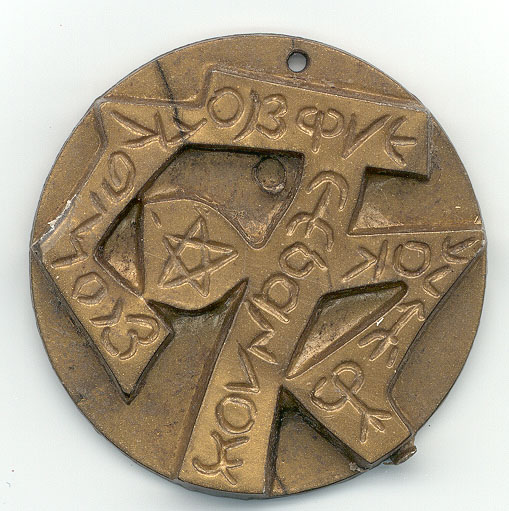
This was one of my favorite films when I was a young child, and we used to see it at least once a year at my school. The effects are crude today, of course, but it's still a cute fantasy for young and old. Here's the best part: remember at the beginning of the article when I mentioned Castle's reputation for gimmicks? Well, ZOTZ! was no exception - all the kids who went to see it in the theater got their OWN plastic 'gold' ZOTZ! coin, which they instantly put to good (or bad) use after the movie, pointing at each other and out-'Zotz'-ing themselves all over the country. My friend Paul swears he still has his ZOTZ! coin, and they still pop up from time to time - here's what it looked like:

http://www.theancestors.com/zotz-coin.JPG

It was also the only movie I can recall where Castle also brought the Columbia 'torch-lady' logo to life at the opening and closing of the film - she even speaks! For some reason, that always sent a thrill of uneasiness through me! :) If you'd like to experience ZOTZ! for yourself, you're in luck - it comes out October 20th on DVD as part of the William Castle Collection ... so pick it up, or else ... ZOTZ!

Next Time: To the land of the Djinn we go for the first of three DIFFERENT showings of THE THIEF OF BAGHDAD!

Thursday, September 10, 2009

THE MUMMY (1932) (shown January, 1992)


Ah, there you are! Welcome back ... I'll be with you in a moment, I'm just looking for a certain ... now where did I put ...? THERE it is! What's that? Letter? No, my friend, this isn't a letter, it's a very particular Scroll ... here, have a seat and let me read it to you ... then again, maybe I shouldn't. I still remember what happened to poor Norton, back in the day with the Whemple expedition, when he read it - completely mad, they said, until the day of his death. Well, we won't read ALL of it, just the beginning. Are you ready?

"This is The Scroll of Thoth. Herein are set down the magic words by which Isis raised Osiris from the dead. Oh! Amon-Ra -- Oh! God of Gods! -- Death is but the doorway to new life --- We live today - we shall live again -- In many forms shall we return - Oh, mighty one."

These words set the tone and open 1932's THE MUMMY, the first in a very successful film series for Universal Studios, as were their Frankenstein and Dracula series. In an interesting sidenote, both THE MUMMY and DRACULA open to the strains of Swan Lake - it would take Max Steiner's wonderful score to 1933's KING KONG to get the ball rolling with synchronous music scored to the action on the screen, instead of library cues.

THE MUMMY was Boris Karloff's fantastic follow-up to his role as the Monster in 1931's FRANKENSTEIN. As with that film, he once again had to undergo hours of makeup preparation with master makeup artist Jack Pierce, with amazing results. In many ways, this film was probably harder for him, as he was actually portraying three characters: the High Priest Im-Ho-Tep (in the flashback scenes of Ancient Egypt); the accursed titular immortal Mummy, thousands of years old when discovered by the Whemple expedition at the beginning of the film; and (after being brought back to life), Ardath Bey, the 'expert' of Ancient Egypt and hidden tomb locations, with a knowledge that no one else has ... at least, no one living.

As I wrote in the Lughnasad 1991 issue of HARVEST: "This film has it all: Egyptian magic, reincarnation, and, of course, the Sacred Scroll of Thoth. This last item is what gets Karloff ... into trouble, as he steals the scroll to resurrect his beloved Princess Anck-es-en-Amon from the dead...

Im-Ho-Tep's punishment for the attempted resurrection is to be mummified and buried alive in a forgotten grave near his beloved Princess (Zita Johann), as her guardian throughout eternity. The scroll is buried with him so that none would repeat his sacrilege ... Im-Ho-Tep is dug up and
one ... young archaeologist (Bramwell Fletcher) translates and reads the scroll aloud (after translating and ignoring the inscription of death to the defilers of the tomb), bringing the mummy back to life. The mummy grabs the scroll and shambles into the desert, leaving behind one very insane young man.

Ten years later, due to his repeated rituals with the scroll, Im-Ho-Tep has achieved a tenuous semblance of life and is able to pass himself off as "Ardath Bey". With his knowledge of ancient Egypt, he leads the latest batch of explorers to the tomb of his beloved. After the coffin of his Princess is safely exhumed and stored in the Cairo Museum, he begins his spells to call her back to him from across the gulfs of Time. His call is subconsciously heard and answered by Helen Grosvenor (Zita Johann, again), daughter of the Governor of the Sudan and the reincarnation of Anck-es-en-Amon. Once they meet, Im-Ho-Tep is unhinged and, overjoyed to find his love again, spends the remainder of the film killing off anyone who gets too close to the truth.

At the climactic ending, he has hypnotically called the young woman to the museum and adorned her in royal raiments. The one catch to her becoming immortal, however, is that she must die first to free her of her current life's memories. This doesn't sit too well with our heroine, who, on the verge of being sacrificed, rushes to a statue of Isis and begs Her for divine mercy. In a marvelous final touch, Isis hears her plea for help ... and raises a glowing ankh, which sets fire to the scroll and sends the mummy crumbling to dust.

THE MUMMY was a HUGE hit when it was shown at Conjure Cinema, probably the largest crowd we had to that time. Part of it, admittedly, may have been sheer January stir-craziness, what with all the snow and freezing temperatures - and the shared warmth of a number of people jammed into a small screening room watching a movie about WARM Egypt ... but the more interesting part to me afterwards was finding out that, although everyone KNEW what "The Mummy" looked like, how very few of them had ever actually SEEN the movie! It was a very pleasant revelation all around, and still holds up well today, so many decades after it's making. It is also (unlike many films described here) available in a number of different DVD editions, so you should have NO trouble tracking it down.

So there you have it, my friend. Ah, unfortunately, it looks like I may have read TOO much of that scroll, after all ... that shuffling sound? No, no, just leaves going by the open window, I'm sure - I'll get up and close it while you wait here ... I (or someone - or some - thing) will be right back ...

Next Time: Explore one of my childhood favorites - get your magic coins ready for ZOTZ!

Wednesday, September 9, 2009

FIVE MILLION YEARS TO EARTH (aka QUATERMASS AND THE PIT) (1967) (shown December, 1991)


Nothing says Christmas like the total destruction of Planet Earth - and that's just what CC revelers were in store for with our final show of 1991.

The history behind the film is more twisty than a pretzel, so stay with me here. British scientist Bernard Quatermass was one of the UK's best-known "science-fictional" characters, second only to Dr. Who among all red-blooded British boys and girls of the 1950s and '60s, although very few books were ever written about him. Screenwriter Nigel Kneale developed the character as a "hero scientist", the head of the British Experimental Rocket Group. He was introduced in the BBC 1955 television serial THE QUATERMASS XPERIMENT (yes, that IS how it was spelled), followed by the sequels QUATERMASS 2 (1957) and QUATERMASS AND THE PIT (1958-59).

The character and stories proved so popular they were remade for motion pictures, with the THE QUATERMASS XPERIMENT (1955) (known as THE CREEPING UNKNOWN in the US) followed by QUATERMASS 2 (1957) (known as ENEMY FROM SPACE in the US) and our film under discussion, QUATERMASS AND THE PIT (1967) (released in the US under the FIVE MILLION YEARS TO EARTH banner).

Confused yet? Wait, it gets worse - Quatermass as Kneale wrote him was an acerbic, no-nonsense scientist who did not suffer fools gladly, and who could see the outer space horrors being visited on the Earth long before others even dreamed them. Quatermass was very well described and fleshed out in Kneale's writing, but he was played by a different actor each time, with different interpretations. By the time Andrew Keir inherited the role for FIVE MILLION YEARS TO EARTH, Quatermass had been played by four other actors, with American actor Brian Donlevy's interpretation of the character being the least well-regarded.

I came into this whole witches' brew completely ignorant of all this. Keir's Quatermass in this film was my first impression of the character, and that's how I always remember him, no matter who plays it now (similar to the argument of "who's the best DOCTOR WHO?"). This was another film I caught up to as a child on TV, and one that (especially the ending) raised the hairs on the back of my neck semi-permanently.

The plot involves a spaceship uncovered in a newly constructed London Underground subway station at Hobb's End. The military think it's a leftover unexploded bomb, but Quatermass knows different. He and fellow scientist Dr. Roney (James Donald) drill into the inside of the ship (after much difficulty), and in doing so release a vibrational force that triggers a race memory in certain people. The ship is found to have come from Mars, back when mankind was still young, and peopled by Martians (who look like giant three-legged crickets with horns) - a number of whose preserved bodies are found in an inner chamber.

Quatermass hopes to get a visual impression of the force that's setting everyone's teeth on edge, and with a new invention of his, is able to record the race memory through Roney's assistant Barbara (Barbara Shelley). The playback shows the genocide of the Martians, the survivors escape to Earth and their enslavement of certain cavemen to their will - those they could not control, they killed.

Showing the recording to the military, Quatermass pleads his case to stop the excavation of Hobb's End and the unknown forces that are still building there. Colonel Breen (Julian Glover) denounces Quatermass as a quack and charlatan and resumes the excavation, inviting the media to watch and record it, with disastrous results. The Martian vibrational force is magnified a thousandfold, spreading out over London and tapping into the minds of humans who have similar brain patterns to the earlier cavemen, and who are now receiving the same orders from a millenia ago - kill anyone who is different and can not be controlled ... including Roney.

The finale shows London rapidly collapsing, as the force spreads out from Hobbs's End, and Quatermass and Roney solving the final piece in the puzzle. Researching the area, they found a history of psychic disturbances, reports of hauntings, etc. Quatermass realizes the name for the area was originally Hob's End ('Hob' being a old term for the Devil). He also theorizes that the race memory of ancient Man has transmuted the horned Martians into our modern conception of the Devil and our accompanying idea of Evil. The force manifests itself as a gigantic horned Martian, growing larger and more powerful by the second, and setting Mankind off on a second genocide.

Dr. Roney, one of the few men unaffected by the force, climbs an iron building crane and swings it into the Martian energy manifestation, but at the cost of his own life. Grounded, the world is saved, and Quatermass and the survivors begin to rebuild their lives.

To get a taste of Red Planet Madness, here's a link to the trailer: http://www.youtube.com/watch?v=v5xPvFjPhkQ. A wonderful film all around, it comes with my highest recommendation.

Next Time: We walk like an Egyptian, as 1992 shambles onto the screen courtesy of Boris Karloff as THE MUMMY!

Friday, September 4, 2009

SORCERESS (aka LE MOINE ET LA SORCIERE) (1987) (shown November, 1991)


The first of our foreign films shown at Conjure Cinema was also the best. SORCERESS (as it was known in America) came in under the radar, playing in art house theaters and slowly and surely gaining a sleeper reputation by word of mouth. I first heard about the film this way, being highly recommended to me by a friend of mine, and by a happy piece of synchronicity, we happened to get it in on video at my office.

I took the film home to view it, and was blown away. This was EXACTLY the kind of thing I was looking for, something few people had seen, that would resonate with a new audience who would hopefully spread the word about it.

The story takes place in 13th Century France, and concerns Etienne de Bourbon (Tcheky Karyo), a Dominican friar and religious zealot on the hunt for witches and heretics. Arriving at a small French village, he is enraged to find a young 'wise woman' Elda (Christine Boisson) who the villagers come to for herbal cures and folk remedies for their illnesses, all with the seeming blessing of the local priest.

As the friar and the 'sorceress' exchange views on the ways of the world and what constitutes Divinity, he develops a grudging admiration for her, and must weigh this against his sacred duty of exterminating those who have 'turned against God'. The film is a gentle, yet suspenseful, tale of two people trying to get each other to see, if not the other's views, then a common ground. One is more and more worried as the film progresses that the lovely and wise Elda is NOT going to make it to the final reel.

The film was written by Pamela Berger, a Boston College medieval scholar, and directed by Suzanne Schiffman. Here's the kicker: Pamela developed the scenario from the writings of the REAL Etienne de Bourbon and his discovery of the shrine of St. Guinefort ... a holy greyhound.
For more on the original story and legend, may I recommend the wonderful Green Canticle website:

http://images.google.com/imgres?imgurl=http://greencanticle.com/wp-content/uploads/2008/09/the-sorceress.jpg&imgrefurl=http://greencanticle.com/2008/09/05/st-guinefort-the-sorceress-the-dominican-inquisitor/&usg=__zgrUuBqiZoU3x3QE1t_BHxPWYyA=&h=500&w=500&sz=49&hl=en&start=2&sig2=1XtzobkOUsKF2wXxUproRw&tbnid=-xprJElM9_YvhM:&tbnh=130&tbnw=130&prev=/images%3Fq%3Dsorceress%2B1987%26gbv%3D2%26hl%3Den%26client%3Dfirefox-a%26rls%3Dorg.mozilla:en-US:official&ei=ECWhSqrhDOKzmQewjdn5DQ

SORCERESS was a BIG hit at Conjure Cinema, and achieved exactly what I had hoped: more word of mouth for a wonderful film, and a testing of the waters for the (occasional) classy/arthouse title. Track this one down if you haven't seen it - you won't be sorry.

Next Time: Back we go to more "Earthly" pursuits - FIVE MILLION YEARS TO EARTH, to be precise!

Thursday, September 3, 2009

LAIR OF THE WHITE WORM (1988) (shown October, 1991)

Bram Stoker (1847 - 1912) is best known, of course, for the novel DRACULA, and all the subsequent adaptations that were to follow, both on stage and in film. He did write other novels, however, including THE LAIR OF THE WHITE WORM (aka THE GARDEN OF EVIL), which was to be his final work, published in 1911, one year before his death.

The film version of the novel was released in 1988, directed by Ken Russell and starred Amanda Donohoe as Lady Sylvia Marsh, last acolyte and High Priestess of the snake god Dionin. It turns out Dionin is also the legendary "d'Ampton Worm", who is still very much alive and being fed errant travelers, unwise spelunkers, and whoever else the immortal Lady Sylvia can get her claws (and poison-spitting reptilian fangs) into. Speaking of her fangs, one drop of the venom from them will cause nightmarish hallucinations (courtesy of Ken Russell and his special effects department), as two sisters, Mary and Eve Trent (played by Sammi Davis and Catherine Oxenberg) find out. When Eve is abducted by Lady Sylvia as the next sacrifice to Dionin, it's up to the Lord of the Manor, James d'Ampton (Hugh Grant) and a Scottish archaeology student (Peter Capaldi) to come to the rescue and put an end to the herpetological horrors.

Interestingly, Stoker based part of his novel on a well-known legend in the UK, that of the Lambton Worm (which you can read about here: http://en.wikipedia.org/wiki/Lambton_Worm). Russell slightly changed the name (from Lambton to d'Ampton), but thanks to the film, the legend lives anew.

Russell's film is a very uneasy mix of horror and humor, first lulling you into a false sense of security with some very slinky (and kinky) acting from Amanda Donohoe, and then turning on a dime with a graphic horror sequence involving the aforementioned venom, showing the desecration and rape of nuns in ancient times. From that point on, your cage is rattled (or is is rattlered?) for the rest of the film, not knowing what Ken Russell has up his sleeve.

Recommended, but probably NOT for the squeamish, LAIR OF THE WHITE WORM is one to watch curled up and home with your sweetie ... but make sure they're not afraid of snakes!

Next Time: We FINALLY get around to showing some much-needed culture at Conjure Cinema with the French masterpiece SORCERESS!

Wednesday, September 2, 2009

THE DEVIL'S BRIDE (aka THE DEVIL RIDES OUT) (1968) (shown September, 1991)


During the 1950s and '60s, Dennis Wheatley was one of the most widely-read and best-selling authors in the English language ... today, he is all but forgotten. He wrote a series of occult/black magic thrillers with such titles as The Haunting of Toby Jugg, The Ka of Gifford Hillary, and They Used Dark Forces. Arguably his most famous fictional character was the Duc de Richleau, a British noble, soldier of fortune, and occult authority, who battles the Devil in all his forms.

Christopher Lee knew Wheatley and prevailed upon him for the rights to make a film of his best novel, The Devil Rides Out, with Lee himself to play de Richleau (in one of the few non-villainous roles of his career). Hammer Films was a perfect choice to host this diabolical tale, and they pulled out all the stops, with effects ranging from hypnotic demons, giant spiders, magic circles, and the appearance in the flesh of "The Goat of Mendes ... the Devil Himself!"

Charles Gray plays Mocata, leader of the Devil cult that de Richleau and his friends battle (in a part which Wheatley based on the life and legend of Aleister Crowley). This would be the third time a role based on Crowley would be put to film: the occultist was also used as the villain in 1926's THE MAGICIAN (where he would be billed as 'Oliver Haddo' and be played by Paul Wegener) and 1934's THE BLACK CAT (where he would be billed as 'Hjalmar Poelzig' and be played by Boris Karloff). While all three performances are impressive, Gray's is the most underplayed and commanding, at one point stopping a knife attack to the chest by staring down his attacker (seen in the trailer to the film: http://www.youtube.com/watch?v=zcp1e4gNKIc).

While a modest success at the time, it did not do well enough to spawn the series of Wheatley films that Lee had hoped for, with Hammer adapting only two other Wheatley novels, 1968's THE LOST CONTINENT (based on Wheatley's UNCHARTED SEAS), and 1976's TO THE DEVIL ... A DAUGHTER (based on the novel of the same name). Interestingly, Christopher Lee has stated recently that THE DEVIL'S BRIDE was one of his favorite film roles, and he would like to see the film redone, with the new special effects available today, and himself repeating the role of de Richleau as an older man, the way Wheatley originally wrote him. I would like to see that, as well. Until then, we have this fine adaptation which comes with my highest recommendation.

Next Time: We hop, skip and slither our way to Bram Stoker's LAIR OF THE WHITE WORM!